

The connectivity guests don't see, but always feel
In hospitality, the ideal technology is the one that's never noticed... until it fails. A room phone that won't connect to the front desk, a property management system disconnected from the phone system, or an emergency call that doesn't arrive in time — these are failures no hotel can afford. Grandstream's GHP Series was designed exactly to eliminate that risk: rugged, elegant, and fully customizable IP phones, natively integrated with the UCM6300 communications platform and managed from the cloud with GDMS (Grandstream Device Management System).
For integrators, ISPs, and distributors serving the hospitality vertical across Mexico, Brazil, and the rest of LATAM, the GHP Series isn't just a room phone — it's the gateway to a complete communications, networking, and security ecosystem that solves three critical needs for any hotel property, small, mid-size, or resort, in a single project.
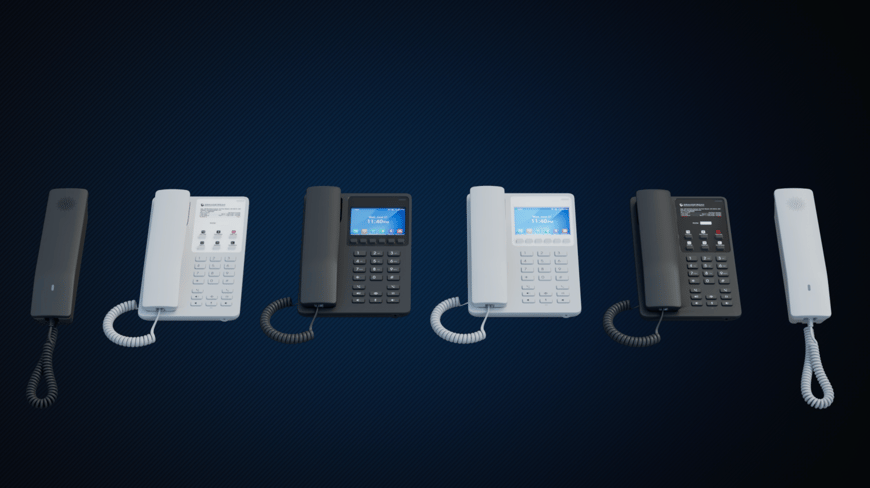
1. The GHP Series: variety and customization for any hotel project
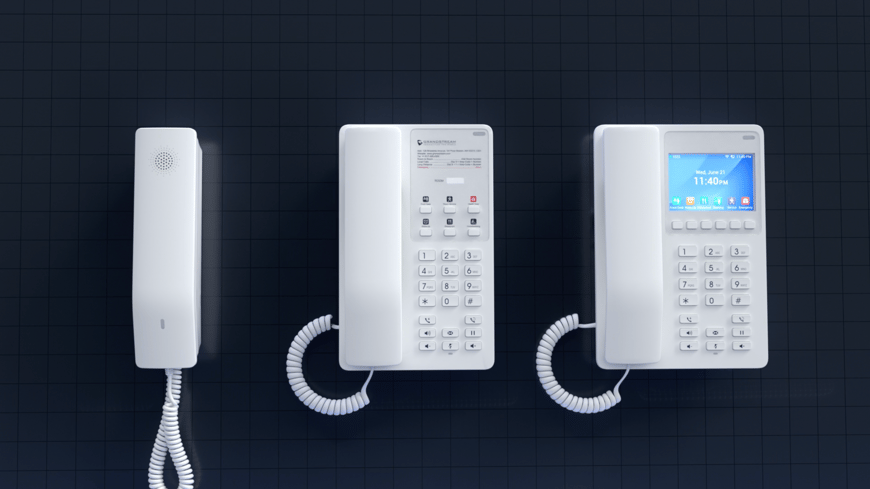
Grandstream offers three families within the GHP Series, designed to fit the budget, category, and design of every property:
- GHP610/GHP610W and GHP611/GHP611W — The most compact model, ideal for standard rooms, student housing, or staff areas. Interchangeable front plate to customize the hotel's logo without changing the unit.
- GHP620/GHP620W and GHP621/GHP621W — A step up in size and features while keeping the customizable front plate, ideal for boutique and mid-category hotels seeking a consistent brand image in every room.
- GHP630/GHP630W and GHP631/GHP631W — The premium model of the series, with a 3.5" color LCD screen (480x320), 6 context-sensitive programmable keys, and a USB-C charging port, built for suites, luxury hotels, and resorts where the guest's visual experience also communicates the property's category.
Why does this matter commercially? Because a single integrator can cover an entire hotel group's portfolio — from the chain's economy property to its flagship — with one product family, one management system, and one technical training. This reduces support costs, simplifies channel inventory, and speeds up the sales cycle.
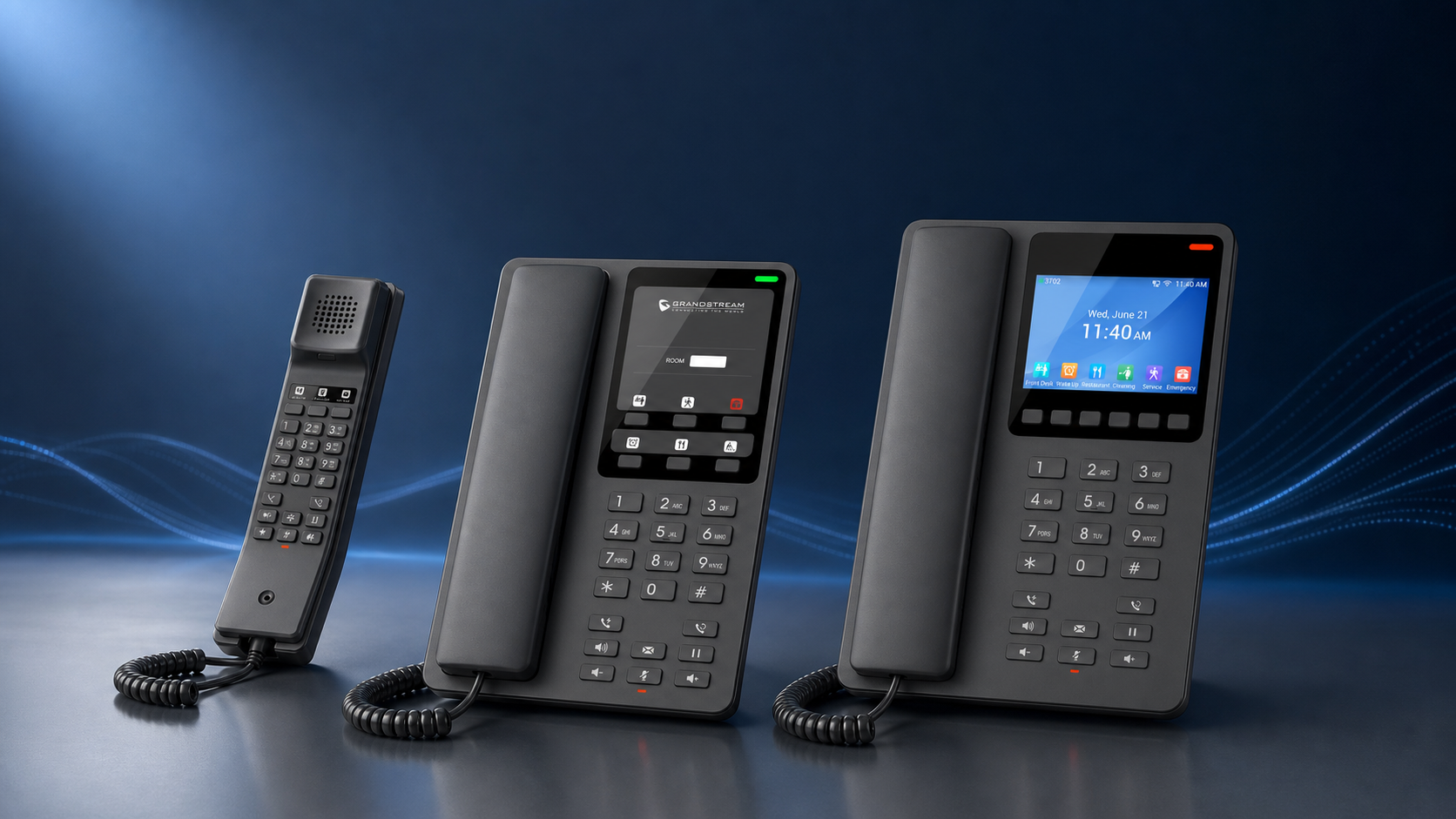
All models share key enterprise-grade attributes:
- 2 SIP accounts/lines with 3-way audio conferencing.
- Full-band OPUS voice codec and an advanced jitter-resilience algorithm (tolerating up to 30% packet loss without affecting voice quality) — critical on hotel networks with high user density.
- PoE power on the wired models (GHP610, GHP611, GHP620, GHP621, GHP630, GHP631), reducing cabling and electrical failure points during installation. Important: the Wi-Fi models (GHP610W, GHP611W, GHP620W, GHP621W, GHP630W, GHP631W) do not have integrated PoE — they are powered via their included power adapter, since that circuitry is replaced by the Wi-Fi radio.
- Enterprise-grade security: secure boot, random default password, unique per-device certificate, and 256-bit AES encryption for configuration.
- Hearing-aid compatibility (HAC) and an antibacterial housing tested under ISO 22196:2011 (GHP610/611 and GHP620/621).
- Key differentiator for Diamond-category properties: ISO 22196:2011 antibacterial housing In high-category hotel quality certifications (such as Diamond categories), the antibacterial housing on the room phone is not an optional extra — it's a compliance requirement that many hotels explicitly demand in their purchasing specifications. The GHP610/GHP610W, GHP611/GHP611W, GHP620/GHP620W, and GHP621/GHP621W already carry this certification from the factory, at no additional cost and with no special finish required on request. This is a sales argument many integrators overlook, and it can be decisive in an RFP or bidding process where this requirement is mandatory. (Note: the GHP630/GHP631, by prioritizing the color LCD screen, does not include this certification — for properties where the antibacterial requirement applies to all rooms, including suites, it's recommended to validate this point with the client before proposing the premium model in those rooms.)
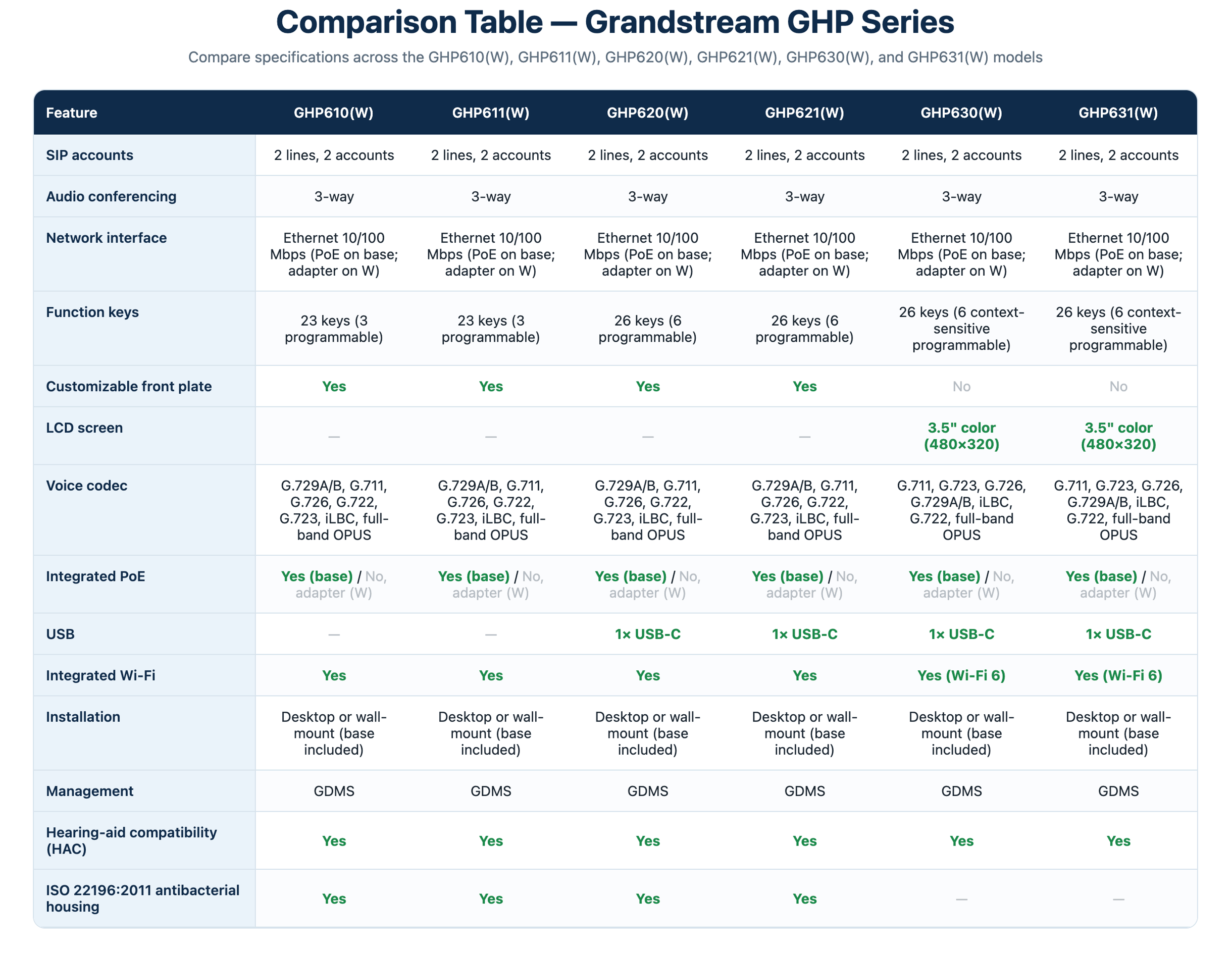
Power note: "Yes (base)" refers to models without the W suffix (GHP610, GHP611, GHP620, GHP621, GHP630, GHP631), which have integrated PoE Class 2. The Wi-Fi models (GHP610W, GHP611W, GHP620W, GHP621W, GHP630W, GHP631W) do not support PoE and are powered via their included power adapter.
The models with integrated Wi-Fi (GHP610W/611W, GHP620W/621W with dual-band Wi-Fi, and GHP630W/631W with Wi-Fi 6 dual-band 2.4/5 GHz) eliminate the need to run dedicated Ethernet cabling to every room — a direct installation cost saving for renovations and historic hotels where cabling is expensive or invasive. Important note: the W models are powered via a power adapter (not PoE), so each unit requires an available power outlet near its installation location.
GHP610: the solution that was missing for bathrooms, elevators, and common areas
In high-end hotel categories (including Diamond categories), it's common to require a phone inside the room's bathroom, in addition to communication points in elevators, kitchens, and restaurant areas. This type of installation calls for a compact, wall-mounted handset-style unit — something the hotel telephony market typically only offers through premium brands at high prices.
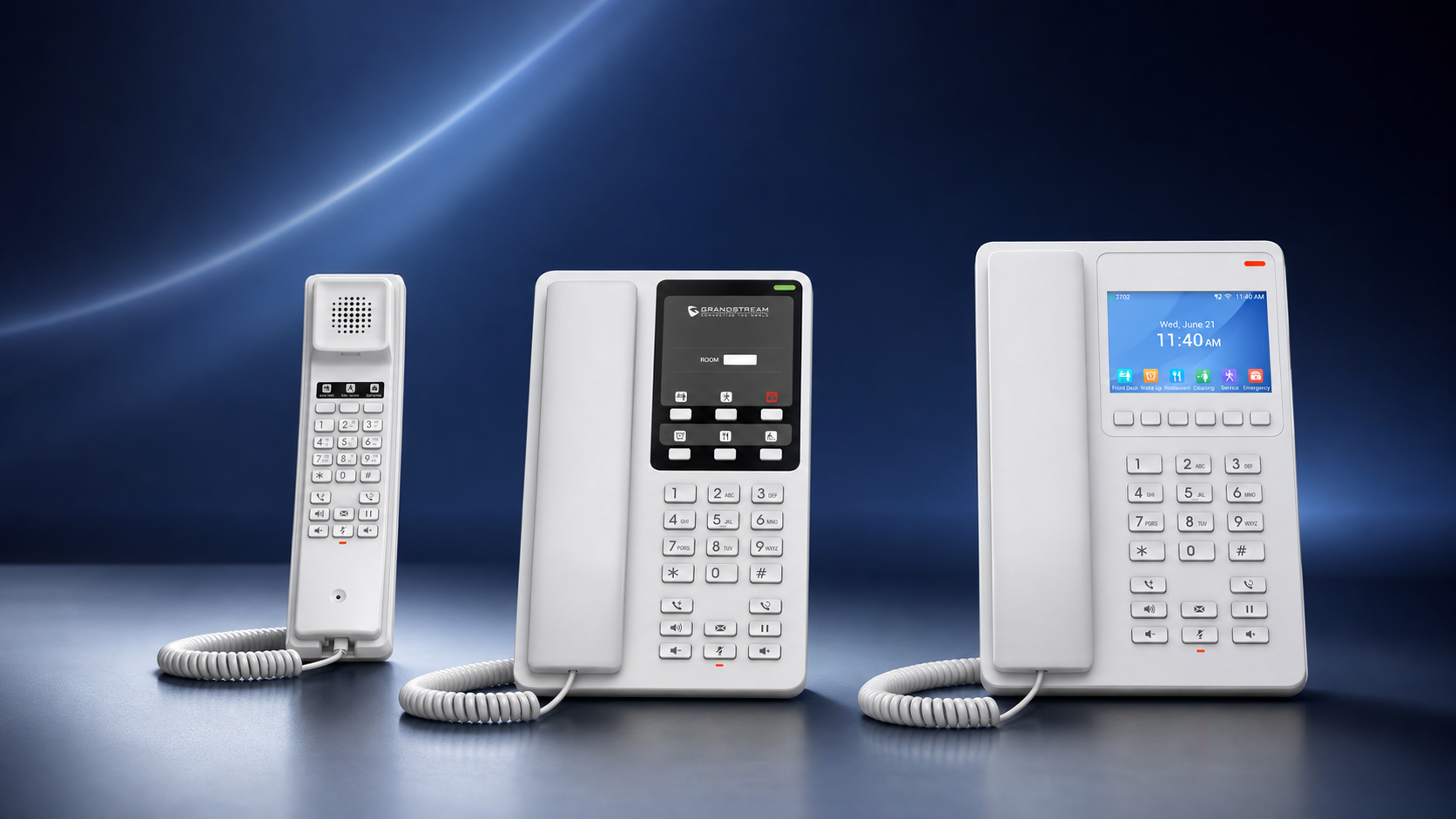
The GHP610/GHP610W, thanks to its compact handset-style form factor, covers exactly this niche: wall installation inside the bathroom, in elevator cabins, in kitchens, or in restaurant staff areas, without sacrificing HD audio quality or the enterprise features found across the rest of the series. This lets the integrator meet that specific category requirement without having to move up to a significantly more expensive competing brand just for that installation point — everything stays within the same Grandstream ecosystem, with the same GDMS management.
Free faceplate customization: the Grandstream front-plate design tool
One of the strongest — and most underused — commercial differentiators of the GHP Series is the free hotel faceplate self-design tool:
🔗 https://ghp-faceplate-tool.grandstream.com/
With this tool, the integrator or hotel itself can design, preview, and print the customized front plate for the GHP610/611 and GHP620/621 (logo, colors, hotel brand typography) at no design cost and with no minimum order. This contrasts directly with competing brands — up to 3 times more expensive in the hotel telephony segment — where custom faceplate design is charged separately and produced only on a per-order basis, with additional lead times. For the integrator, this means being able to offer brand customization as an immediate, no-extra-cost value-add, speeding up the close with a hotelier who values brand image in every room.
2. Centralized cloud management with GDMS
Every phone in the GHP Series — in a 20-room property or a chain with 50 properties — is managed from a single console with GDMS. For the integrator, this translates into concrete commercial advantages over other brands:
- Mass provisioning: onboard hundreds of phones in minutes using configuration templates, with no need to touch each unit individually.
- Real-time remote monitoring: connection status, audio quality, and failure alerts, enabling proactive support before the guest reports a problem.
- Remote firmware updates (FTP/TFTP/HTTP/HTTPS) and a 15-second fast boot, minimizing maintenance windows.
- Multi-property management: hotel chains and hospitality management groups can oversee all their LATAM properties from a single dashboard, without relying on on-site technical staff at every hotel.
This cloud-management model turns the integrator into a recurring-value provider: not just an installer, but someone who can offer remote management and support contracts as a service (MRR) — a strong commercial argument against the competition.
3. Integration with Oracle OPERA PMS and other market systems
One of the biggest headaches in a hotel project is the disconnect between the property management system (PMS) and the phone system. Grandstream solves this at two levels:
Direct integration: UCM6300 series + Oracle OPERA PMS
Grandstream's UCM6300 series features native integration with Oracle OPERA PMS, one of the most widely used hotel management systems globally. This allows key operational processes to be automated without manual intervention:
- Automatic check-in/check-out synchronization: when a guest is registered in OPERA, the room extension is automatically activated with the guest's name, and deactivated at check-out, preventing improper calls to empty rooms.
- Automated wake-up calls scheduled directly from the PMS or the front desk, with confirmation logging.
- Automatic call accounting for long-distance or international calls, billed directly to the guest's account.
- Do Not Disturb (DND) status synchronized between the room phone and the housekeeping/PMS system.
- Minibar and housekeeping reports from the room phone to the central system.
Flexibility: middleware for any PMS on the market
Not every hotel in LATAM runs OPERA. For properties using Cloudbeds, Protel, Fidelio, RMS, Hotelogix, or local/regional PMS systems, Grandstream works with specialized PMS-PBX integration middleware (for example, HSMI/HotelKit-compatible platforms via API or industry-standard protocol) that translate PMS events into the UCM6300's protocol, replicating the same check-in/out, DND, and billing automations without relying on costly custom development. This gives the integrator the freedom to sell the telephony project into any hotel, regardless of which PMS is already installed — a differentiating argument against integrators who can only offer closed integrations.
No external PMS? The Local PMS module turns the UCM6300 into the hotel's operational core
Not every hotel — especially boutique, budget, or newly opened properties — has a PMS installed, often due to licensing costs. This is where the Local PMS module, included natively in the UCM6300 series (no additional licenses or extra cost), becomes an underused commercial gem:
- Turns the UCM6300 itself into the hotel's room operations management system, with no dependency on Oracle OPERA or any external PMS.
- Enables managing check-in/check-out, room status, DND, wake-up calls, and call billing directly from the phone system, with no third-party PMS licensing fees.
- The ideal solution for the integrator who wants to offer real added value to a small or boutique hotel without the budget for a full PMS, closing a more complete sale (telephony + basic operations management) without depending on a third party.
- Since it's included in the UCM6300, it represents no additional licensing cost for either the integrator or the hotel — it's simply another feature of the platform already being sold.
This module doesn't replace a robust PMS like OPERA in a large-scale resort, but it's an extremely strong commercial argument for the small and boutique hotel segment, which represents a significant share of the LATAM market.
4. Guest emergencies: direct communication when it matters most
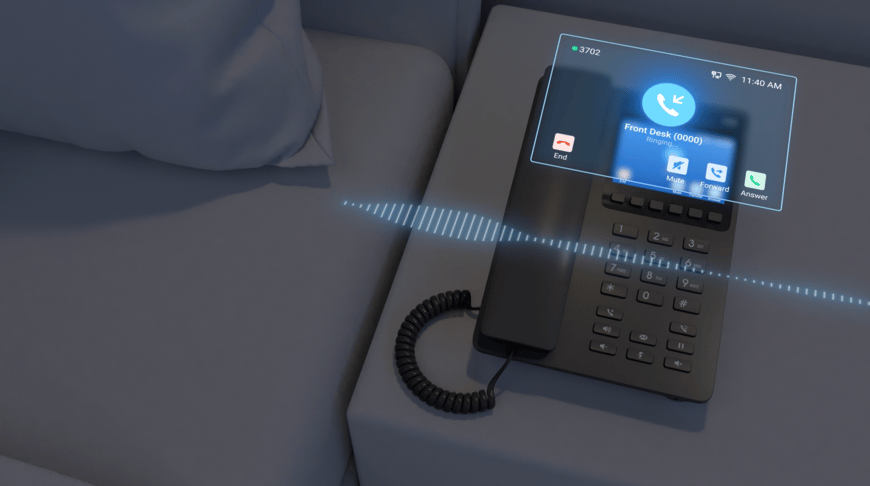
Guest safety is non-negotiable, and here the GHP Series together with the UCM6300 adds a layer of operational peace of mind:
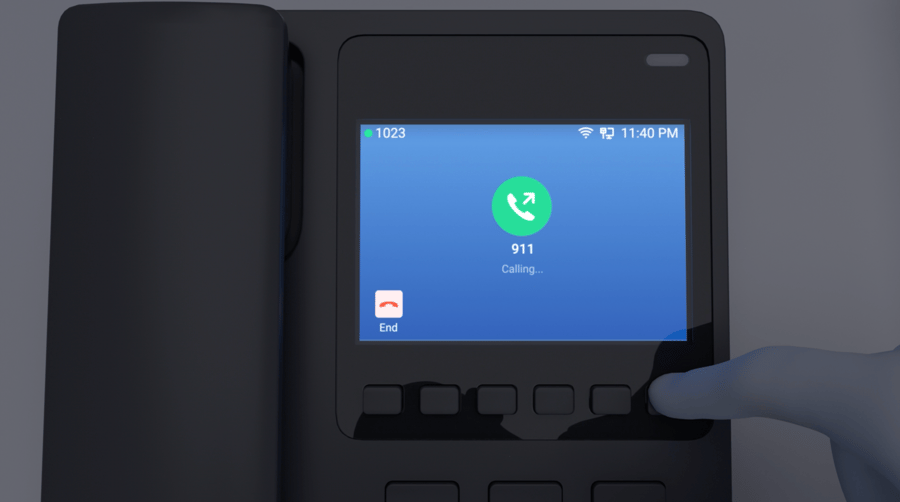
- E911 service support built into the GHP phones, allowing any emergency call from the room to automatically include the specific location (room number/extension), complying with location-identification regulations for emergency calls.
- Configurable emergency call routing in the UCM6300: the hotel can set an emergency call to route simultaneously to the front desk, internal hotel security, and external emergency services (police, fire, ambulance), guaranteeing an immediate response both inside and outside the property.
- Multicast paging, useful for evacuation announcements or general alerts to all rooms and common areas simultaneously from a single point.
- GDS door integration (GDS door-opening support across the entire GHP Series), enabling coordinated emergency access control from the same communications ecosystem.
For a hotel's purchasing committee, this emergency capability isn't an "extra" — it's a compliance and liability requirement, and Grandstream delivers it natively, with no additional third-party licenses.
5. Integration topologies: the complete Grandstream ecosystem
The GHP Series reaches its full value when deployed within the complete Grandstream ecosystem: telephony, Wi-Fi network, switching, and cybersecurity, all under one brand and one management console (GDMS).
Topology A — PoE in/out: the key to reducing cabling
A very strong technical-commercial differentiator for hotel installations: Grandstream's GWN7661E and GWN7604 access points feature both a PoE-in (input) port and a PoE-out (output) port. This means a single PoE Ethernet cable reaches the AP in the room, and from there the AP itself powers and delivers network connectivity to a second device — typically the wired (non-W) GHP phone in that same room — without needing a second cabling point or an additional PoE injector.
Important: this PoE-out setup applies to the GHP610, GHP611, GHP620, GHP621, GHP630, and GHP631 models (without W), which do support PoE. If the Wi-Fi (W) version is installed instead — for example, to avoid cabling the room entirely — the phone connects to the network wirelessly, but requires a power outlet and its included power adapter, since the W models do not support PoE.
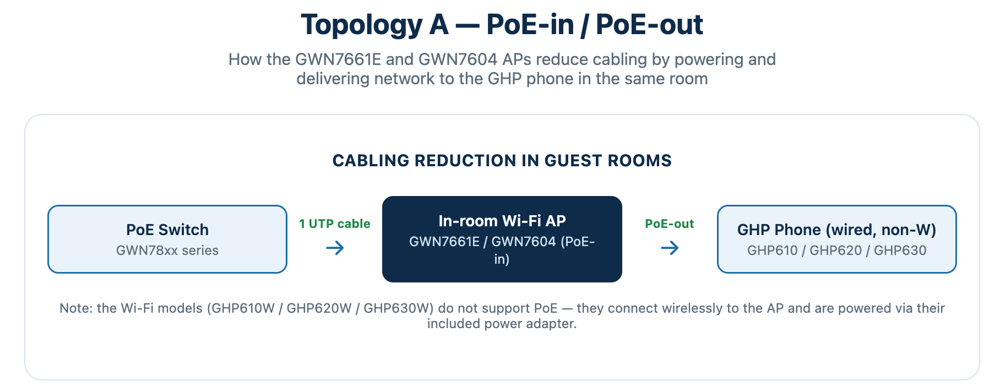
Direct commercial impact: in a 100-room renovation, this can mean eliminating 100 additional cabling points, reducing materials, labor, and installation time — savings the integrator can capture in project margin or use as a competitive pricing argument.
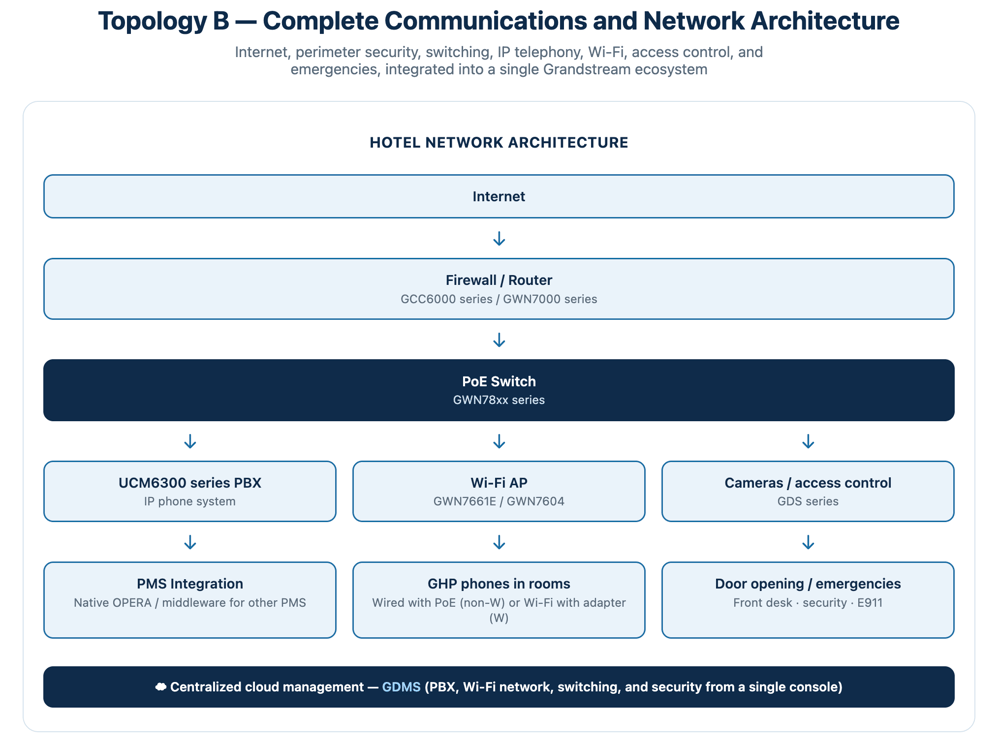
Topology B — Complete communications and network architecture
The entire ecosystem — PBX, network, Wi-Fi, and security — is managed from GDMS, allowing the integrator to offer a single support and monitoring contract for the entire infrastructure, not just the telephony.
6. Implementation examples by property size
Small hotel (15–40 rooms, boutique or economy)
- PBX: UCM6300A (or UCM6302A) with PMS integration via middleware if not using OPERA.
- Phones: GHP610 (wired, with PoE) in standard rooms connected via a PoE-out-capable AP; GHP610W in rooms where avoiding additional cabling is preferred (requires a power outlet); customized front plate with the hotel's logo using the free self-design tool; GHP610 also recommended for the bathroom phone point if the hotel's category requires it.
- Wi-Fi network: 4–8 GWN7605 or GWN7604 APs distributed per floor, with PoE-out powering the wired GHP610 phone in each room from the same network point.
- Switching: 1 GWN7802P PoE switch for the main rack.
- Management: 100% via GDMS, ideal for properties without dedicated IT staff.
- PMS: if the hotel has no external PMS, the UCM6300's Local PMS module covers check-in/out, DND, and wake-up calls with no additional licensing cost.
Mid-size hotel (40–150 rooms, regional or business chain)
- PBX: UCM6300 series with native OPERA PMS integration (or local PMS middleware).
- Phones: a mix of GHP620 (wired, with PoE) or GHP620W (Wi-Fi, with power adapter) in standard rooms, and GHP630/GHP630W (suites and executive rooms, with LCD screen) to differentiate the experience by room category; GHP610 at bathroom, elevator, and kitchen/restaurant common-area points where a compact handset-style unit is required.
- Wi-Fi network: GWN7661E APs in each room/hallway, with PoE-out to the wired (non-W) GHP phone in that room, plus common-area coverage (lobby, restaurant, event halls) with additional APs from the same series.
- Switching: stackable GWN78xx PoE switches per floor for scalability.
- Security: Grandstream security firewall/gateway at the network edge, VLAN segmentation between guest network, hotel operations network, and voice network.
- Emergencies: E911 routing configured to the front desk + internal security + external services.
Resort or large-scale property (150+ rooms, multiple buildings/towers, outdoor areas)
- PBX: UCM6300 series architecture with UCM RemoteConnect or a high-availability cluster for 24/7 service continuity, given the critical call volume and operational demands of a resort.
- Phones: GHP630/GHP630W in premium suites and villas (visual LCD experience matching the resort's positioning); GHP620/GHP620W and GHP621/GHP621W in standard tower rooms; GHP610/GHP610W in room bathrooms, elevators, kitchens, and restaurant staff areas, covering the bathroom-phone requirement typical of Diamond categories without resorting to more expensive premium brands; wired models powered via PoE from the room's AP, W models powered via their power adapter where avoiding cabling is prioritized.
- Wi-Fi network: a combination of indoor GWN7661E APs (with PoE-out for wired GHP phones) and GWN76xx/outdoor series for outdoor areas such as the pool, gardens, and open-air common areas, ensuring continuous coverage across the entire resort grounds.
- Switching: ring or redundant GWN78xx PoE switch architecture per building/tower, ensuring continuity if a link fails.
- Cybersecurity: VLAN segmentation for guest network, administrative network, PBX/voice network, and video surveillance network; Grandstream firewall managing traffic between segments; SecureAccess for secure remote access for IT staff or the integrator to provide remote support without exposing the internal network.
- PMS: native OPERA PMS integration to automate the high check-in/check-out volume typical of a resort, with automatic billing for spa services, restaurant charges, and international calls from international guests.
- Emergencies: multicast paging for evacuation announcements across the resort, plus E911 routing differentiated by zone/building to internal security and local emergency services.
Conclusion: one ecosystem, one complete project
Grandstream's GHP Series doesn't compete as "just another hotel phone." It competes as the gateway to a complete project: IP telephony, Wi-Fi network, switching, cybersecurity, PMS automation, and emergency capabilities, all managed from a single cloud (GDMS) and backed by a single brand. For the integrator in Mexico, Brazil, and LATAM, this means fewer vendors to coordinate, fewer separate trainings, and a much stronger sales argument to the hotelier: a complete ecosystem, scalable from the 20-room boutique hotel to the 500-room resort, with the same quality and management standard at every property.